I came across information over the years that may help the self builder when it comes to retrofits (doing up an existing dwelling).
This is probably the most challenging of self builds as the options are few when it comes to insulating a house that was never designed to be insulated.
The other problem for the self builder is how well were the houses built in the first place -are the construction details good?. If they are good then it may be an easy step (it is evident that today there are problems with new builds. Could it have been any different in the past?)-for example were the cavities clean, state of repair of pointing, brickwork etc., .
A Guide to doing it right
The document below is a very good guideline on renovating an old building correctly when it has solid walls.
Check for any newer versions at their web site.
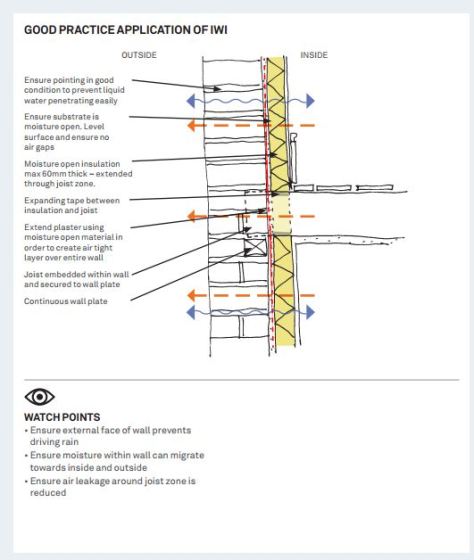
I extracted a sample of the contents from the above guide by way of example.
Solid Wall InsulationSolid Wall Insulation Poor Practice
It also needs to be realised that by adding insulation to a wall that was not designed for insulation can make the house colder if the solution is not correct, structurally damage the wall over time or cause mould on the inside that may affect your health. The above report goes through this.
Objective
The above will hopefully guide the self builder away from the problems and find the correct solution.
One needs to fully understand that one needs to choose the most robust solution that can withstand something going wrong.
Possible Products
Some of these products may be safer to use when it comes to old buildings . Some require extra measures to ensure they keep the building dry and you warm.
The hot water tank is a 300 litre stainless steel tank. Stainless steel is better at reducing stratification (minimising mixing) because it conducts less heat compared to copper. Different grades of stainless steel exist for different types of water (hard/soft). One also needs to check the type of welds used on the tank as some can not cope with certain water types.
The tank was modified to allow me to connect the solar PV water heating system (previous blog) in the future using thermosyphonic action i.e. hot water is lighter than cold water so it naturally flows from the top of the tank to the bottom (Reducing the need for pumps). The DC power from the solar panels will be connected to electric heating elements. As the solar power varies the heating elements will adjust the output power through a control unit I am developing.
Self Build Design
IfI install a solar hot water system or another method in the future this will be done with a plate heat exchanger rather than a coil. I installed extra connections on the tank for this reason. The reason for the heat exchanger is that the tank will heat from the top down. A plate heat exchanger looks like the following
Plate Heat Exchanger
If one opts for a coil it creates turbulence while heating the tank. I found it difficult to find a tank manufacturer who will install the correct surface area of a coil for a climate like Ireland. I feel most are designed for hot countries like Spain where the sun shines and stays shining. If one opts for a coil rather than a plate heat exchanger one requires a large coil surface area to ensure that most of the solar energy transferred in the least amount of time and the temperature returned to the hot water solar panel is at a minimum. In this way the hot water solar panel can operate at its maximum efficiency.
Initially when researching the options available to plumb the house I came across two main methods- Pressurised/Closed or Gravity/Open. I settled for a gravity based system because of the simplicity, DIY, reduced parts and maintainability. If one can increase the height of the gravity tank the pressure will increase at the taps.
Below is a video of what a pressurised/closed system can do (if it goes wrong and probably very rarely). When I was researching pressurised systems I felt that there seemed to be different ways of designing these and providing the necessary safety levels. I do not like systems where there are potentially hidden failures (when a safety device is supposed to work and does not).
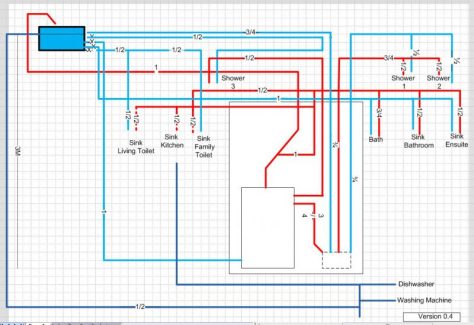
I also was hoping to use gravity to supply the showers but it is becoming more difficult to find a good choice of shower valves and shower heads that work on low pressure . The way around this to keep things simple is to install a shower pump in a central location for two of the showers (see below). One can then use a shower head that helps control the flow rate and keep the water use to a minimum.
For one of the showers I already have a shower valve and head that works well on gravity so I will plumb this separately directly from the tank (shower 3 in the layout below).
Design
The plumbing layout for the house is shown below. (The toilets are fed from a separate gravity tank supplied by the rainwater harvesting system as shown on a previous blog.)
Gravity Fed Design
Materials
I am using Qual-Pex for the plumbing in the house. It varies in price so it is a good idea to shop around (The 1/2 inch varies from €70 to €200 for the same pipe). I ended up using 200 metres of 1/2 inch and nearly 50 metres of 3/4 inch and 25 meters of the 1 inch.
The overflow from the tank needs to be well secured or finished in copper to ensure that if the tank overheats the pipe will not sag/bend or cause a restriction.
The brass fittings are cheaper than the quick connect so I will use these. One needs a good plastic pipe cutter as using a hacksaw is not feasible. I used a Ridgid brand plastic pipe cutter and I am very happy with the quality.
With a plumbing design one needs to ensure that the size of pipes are no bigger than they need to be. One reason for this is that the volume of water in the pipe will cool down and one has to wait for this to run through fully before getting hot water at the correct temperature.
I calculated that 10 meters of 1/2 inch pipe holds approximately 1 litre of water and 10 meters of 3/4 inch holds 2.3 litres. This gives one an idea if a solution is required and the wait time.
The cold water pipes will be insulated as I am concerned that condensation could occur on the surface of the pipe.
I also tried to ensure that the number of connections/joints are kept to a minimum and I tried to place these only at accessible points.
Logistics of getting hot Water to the furthest points.
The kitchen sink hot water supply is too far from the tank so I may develop an on demand system that ensures hot water is available once certain taps are used rather flushing semi warm water down the drain and a one or two minute wait for hot water. Installing instantaneous heaters is not economical.
A way to solve this is only use one 12 volt pump and have a valve at each sink position. This pump will then feed into the gravity header tank rather than the hot water tank (I need to check the regulations) . I want to keep the plumbing connections and electrical devices to a minimum. The power to operate this can be a small solar panel charging a battery.
The plan is to develop a solution around the following -Measure the hot pipe feed temperature, Detect if the tap is going to be used and link this to controlling the pump and valve.
The only item that needs to be purchased is a 12 volt pump and a 12 volt valve and develop the control unit to suit the Irish regulations. I have started on the design of this. In the meantime I will install a third pipe in the bathroom and kitchen for the final solution.
I have been looking for a simple cost efficient way of installing blinds on some of the bedroom windows. The windows are nearly 3 metres above the ground and 2.1 metres wide. I did not want a manual method of using long cords hanging down to the floor level because of the child safety risk.
The blinds only purpose is to block out summer light at night. There are solutions for the outside which are the norm across Europe but these I deem too complex. These same units have multiple purposes such as security, provide darkness and reducing solar gain. The simplest to maintain I feel are shown below from one of the following suppliers . The units will not be used every day (unnecessary in the winter) so they should be reliable. The prices start at around 80 Euro.
For the above I have installed cables to supply power rather than use the solar option. These cables can then be fed from one central point with the appropriate voltage from say a battery charged by solar. I also installed the wiring so that a manual switch can be installed rather than using a mobile phone.
What will be important for the above is to find a blind mechanism that is smooth and reliable. Some of the online prices for these appear to be around €90 for 2.1 meter wide and 1 meter long.
If one wants to go the traditional way then the video below may be helpful. When I priced internal motorised blinds in Ireland they were costing around €400 each.
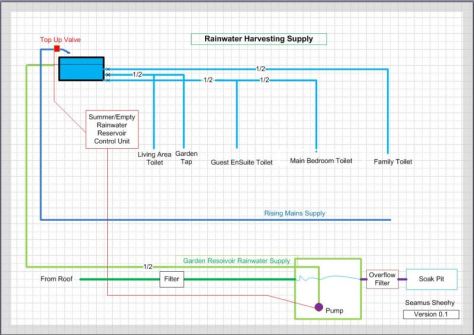
As discussed in an earlier blog I will use the rainwater system to feed the toilets and one outside tap. I have started to install the pipework internally . This involves running a 1/2 inch pipe to each toilet. I note that the Drainage and Waste Water Disposal building regulations state that the pipe used must meet the following-“ for rainwater green / black / green bands and the words RAINWATER in black lettering“. I rang around and no one appears to stock this in Ireland. I note it is available in the UK. Instead I have marked the pipe with permanent marker in the above colours with the words RAINWATER. An image is shown below.
DIY Rainwater
The planned schematic of the rainwater system is shown below.
Rainwater Harvesting
I note that some rainwater systems top up the main tank in the ground if one runs short of water in the summer. I have opted for the header tank where I can manually top up this smaller tank with fresh water or let it automatically bring fresh water to the tank for the duration of the drought with the control unit I built. I feel that topping up the main tank with fresh water is more wasteful.
I am including an Ethernet cable connection to each room. The reason for this is that it provides a more robust signal and has a higher data rate compared to Wifi for internet use. I also ran an Ethernet cable to the TV and Stereo location as these technologies merge with the internet .
In order to install an Ethernet network one needs to select a central point to locate the switch/router and run a separate cable to each room from this position. It only took 3 or 4 hours to do this. The cost of the cable is low approximately €20 for 100 metres . The best value I came across is 305 meters for €49 (www.freetv.ie). There are a few types of Ethernet cable such as CAT5 and CAT6 and combinations of these. I installed the CAT6 un-screened cable as it offers a better performance than CAT5 and maintains the same type of connections that are used today.
The Ethernet cable looks like the following . The cores are twisted together in order to reduce noise. Terminating these cables is tricky (but the tools are low cost at around €10. )
A location worth running the cable to is the kitchen (never know what a kitchen appliance will do next).
For the TV (Terrestrial) one needs a 75 ohm cable and the satellite one requires a 75 ohm cable to match the LNB. The satellite connection needs to be kept short for the optimum signal ( I was told to keep it to less than 10 metres ). The TV 75 ohm cable can be any length. Be aware that there are low quality and good quality cables of the same type. One also needs to ensure that the 75 ohm cable bends on the cable are not below the manufacturers specification as this will increase the signal loss. A good cable manufacturer will state the minimum size of a bend.
A simple wiring diagram of the data cable routes are shown below. As the cable is very cheap it is a good idea also to install one near the front door and distribution board.
Below is my wiring diagram to ensure I do not miss something.
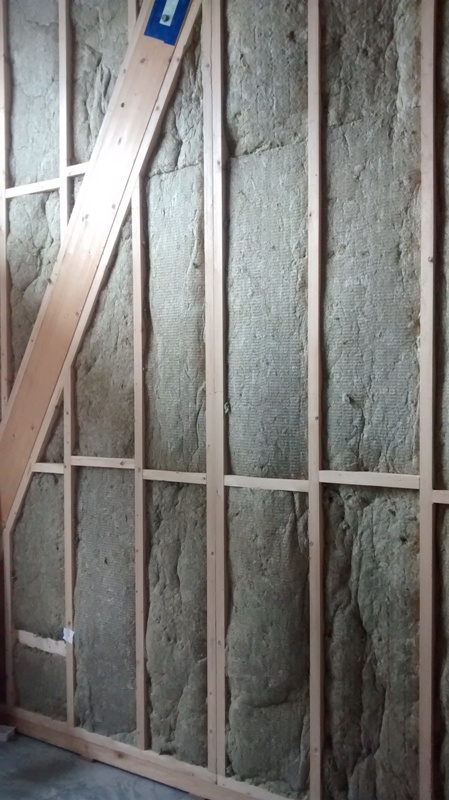
Having recently come across a best practice guide for Electrical installations and their effect on the fire performance of buildings I have decided to change the approach to the fire/acoustic isolation between rooms. I will now install Rockwool flexi 50mm in the 100mm partition walls and Rockwool flexi 100mm in the 140mm partition walls .
Partition before Insulation with WiringPartition wall with Rockwool installed
From an acoustic perspective I was advised that it is better to install the Rockwool in the centre of the partitions rather than touching one or other side of the plasterboard as this limits the sound transfer.
The Electrical Safety Councilbest practice guide deals with Electrical installations and their impact on the fire performance of Domestic premises at thislink when one is building a home. A summary is as follows but the full document is worth reading for any self builder.
Fire containment in the event of a fire
The need to prevent fire from passing through holes in all elements whether solid or lightweight is addressed.
Electrical Equipment is identified that has a direct and significant influence on the fire performance of an element.
Partial Penetrations –those that reduce the fire performance of part of the wall/ceiling or floor.
Full Penetrations-such as ducts and fans that go through both elements of a wall/ceiling/floor.
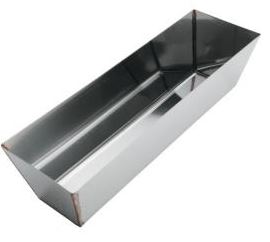
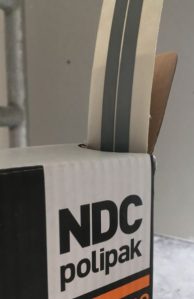
I plan to install as much of the plaster board by myself. There are different techniques for completing the finish. I note that one must use paper between the joints in order to maintain the fire proof rating and the paper jointing material provides superior resistance to cracking. (see www. Gyproc.ie Jointing document)
It appears that the plastic mesh is not to be used even though it is popular.
When the boards are in place there is a special plaster joint coating for the first two coats and a different jointing plaster is used for finishing the joint.
It appears that we will not be able to plaster finish the complete boards as the humidity level in too low and there is a risk that a coat of plaster may crack during the drying process.
For the bathrooms areas around the shower I plan to use magnesium board or cement board as it offers superior water proofing.
Applying the plaster to the joints.
Below are a few videos I located in order to watch and learn from the professionals.
More details that may help
Tools
An important tool if one is doing the plaster board oneself is a plaster board lifter .
Some of these have height restrictions . Some are very professional and expensive and some are low cost. They vary between €150 and €1000.
Some plaster board web sites that I located to date are
Below is the plan to deal with the window/door threshold detail to minimise thermal bridging and provide airtightness.
The window sits on a 30mm piece of Compacfoam . I used Compacfoam 200. I rebated the Compacfoam under the window so that the floor boards would fit under the window and sit on the non rebated edge.
Compacfoam 30mm with rebate (Used router to rebate)
I placed 15mm Compacfoam along the lenght of the window and glued these with Orcon F. The direction of the Compacfoam will determine the floor board direction.
Strips of Compacfoam
I then used 15mm Aerogel to seal around the Compacfoam. Under the window I installed the Proclima profil tape so that I could tape the Intello membrane later.
I left the centre protection tape in place on the Intello profil so that the wooden floor would go in as far as possible on the membrane.
Aerogel 15mm
The Intello membrane was then taped ensuring that it was placed as near to the window as possible . I taped the membrane to the floor . This finished the detail.
Proclima Solitex Plus in place
An example of the possible future wooden floor sample in place is seen below or stone/slate or marble finish.
I will first seal the floor with a product from Lakeland paint in the UK in order to minimise dust. (It looks like a very high eco specification sealer ).
I then plan to install a marble /stone slab to bridge the gap and connect this to the wooden floor.
It is now time to research the solutions available in order to guarantee a fresh air supply into the house, extraction of the stale air and recover heat before the stale air is sent on its way.
There are a number of options -Use the hole in the wall in each room (with no heat recovery), use a central extract system (with no heat recovery), use decentralised heat recovery or a fully ducted heat recovery system .
From previous experience and research the hole in the wall system does not work well taking into account that we have a wind speed of almost twice that of Germany. The system creates draughts and one has only to view the number of vents blocked up and the dependence on the correct speed of wind blowing to supply fresh air in Irish dwellings to realise it does not work.
The central extraction systems either using the stack effect (using temperature differences between the inside and outside) and Bernoulli’s principle (using wind) with no fans is an option. One can use extraction systems that are powered by fans. These do work it appears but they need careful design .
Localised vents in different rooms that use heat recovery such as the Lunos , Aereco and Glidevale iMEV system offer powered heat recovery but when I priced these they were more or less the same price as a fully ducted system and require more holes than I want through the fabric of the building.
Another system recently certified by the Passive House Institute is a heat recovery system that requires two units at either end of a building called (fresh-r). I can see the system working in an open plan environment but the cost is more or less the same as the other solutions above.
If one wants to compare certified heat recovery systems one can use the certified component list on the passive house web site Certified Heat Recovery Products. These products are independently tested by the Passive House Institute.
I will be selecting a centralised heat recovery system because I feel if it is specified, designed , installed and commissioned correctly it offers the best solution. I also plan to use it as a clothes dryer in order to get extra value out of it.
What is in a typical centralised Heat Recovery System,
It typically has two energy efficient fans, a plastic heat exchanger, filters to clean the air, enclosed in an airtight box and a means to control the fan speed. It is a simple unit but the cost is high (in line with the price of other systems above except for the hole in the wall or a stack system)
I was informed recently that the Passive House Institute charges heat recovery manufactures around €60,000 for testing and certification and then there are ongoing yearly costs that need to be passed down to the consumer. A Heat Recovery Company also needs to pay for National test (separate to the Passive House Institute) in different countries which also needs to be passed down to the consumer. There appears to be no European standard test that can satisfy all EU countries.
The product I was originally interested in was from a company called Paul but for some reason the price has risen substantially- I received a price for a Paul 450 unit two years ago and it was €2000 . It is now nearly €3000 -why?. One reason is that that the product was taken over by another HRV supplier Zehnder. I will try not select these products as I see no reason why the price of the unit increased by nearly a €1000. The price above is for large air supply volumes. A three bedroom house may only need a small unit costing 50% less.
Alternative Choices
One of the highest energy efficient certified units available is from a company called Maico-an Irish representative is available. Prices start at around €2400 for a more efficient unit than the PAUL unit . Other options are from Brink such as the Excellent 400 plus also available in Ireland. Systemair Gmbh also have units available in Ireland.
Ducts
I did not think this area was going to be as complex as it is. Lets start-there are different choices of ducts from metal round, plastic round, flexible round, rectangular and all other types of shapes. The bottom line is that large round metal ducts (150-200mm) are the most efficient and quietest and have the lowest air speed.
The flexible ducts vary between two types either Aluminum or Polyethlene with general sizes between 125mm (steel), 90mm, 75mm and 65mm. The smaller the duct equates to more losses- an increase in noise and possible draughts because of the higher air speed (careful placement and selection of the outlets in rooms to minimise these effects are important). I will be trying to select and use a 90mm semi-rigid duct (outside diameter) or larger steel duct. I want to avoid the use of the 75mm duct and all its permutations such as each room being supplied with two 75mm ducts in parallel.
Larger ducts need mufflers or silencers as room noise can travel between rooms . If one has an attic or one can find a way to install the 125mm steel duct with insulation in particular routes the larger ducts may be the best way to go.
Be aware that installing a false ceiling can double the cost of the HRV. I will review all possible systems of ducts . If one uses steel I have been advised that one needs to insulate these as it can take a long time to heat up if the temperature drops leading to colder air being supplied for the initial start up.
The flexible ducts have multiple accessories to connect each part and extra cost is associated with this. The weaknesses of extra connections affects reliability. I will try and simplify the system of connections (somehow).
Ducts need to be cleaned (design and plan for this)
Keep the duct lengths short and straight to minimise losses.
Use large radius bends rather than 90 degree bends.
Consider placing ducts in the foundation when building new.
Some plastic ducts are antistatic (minimises dust collection on inside)
Some plastic ducts have antibacterial liners
Some plastic ducts are odourless and use physiologically and toxicologically safe polyethylene.
Some plastic ducts are smoother on the inside than others (minimises losses and reduces noise).
The non monetary factors for using a centralised Heat Recovery System that I can think of are:
■ comfort (help to filter diesel particles , pollen, outside smog etc from the forced incoming air)
■ building protection and health/hygiene (remove high level of moisture from cooking, showers, baths, and people that could damage the fabric of the building, CO2 from persons in the house and VOC (chemicals from furniture, beds, floor carpets, paints, plastics etc) and supply enough oxygen to get a good nights sleep. Reduced noise because windows do not need to be left open and no holes exist in the outer walls of bedrooms.
■ security (can keep windows closed)
■ thermal energy efficiency (recover up to 90% of the heat energy leaving the building)
The Plan
I want to see if I can design the HRV with the 150/125mm steel ducts or use the 90mm polyethylene outside diameter ducts with the antibacterial liner, antistatic liner and low emission polyethylene.
Each of the polyethylene ducts return to either a supply manifold or extract manifold (see example below).
HRV Manifold
If I end up selecting the 150/125mm steel ducts these will use no manifold and the individual rooms are tapped into the main duct.
Extra Functionality Planned For the HRV
In order to get the most value from the centralised Heat Recovery Unit I plan to make a special cabinet to dry clothes using a feed and return air supply. I will add a heater to the cabinet to give the clothes a drying boost where necessary.
Calculators
An interesting calculator I found is one that calculates the losses of ductwork and air speed. One can experiment using rectangular versus round ductwork and the inner roughness of the ductwork here. One can see the air speed change as one reduces the size of the ducts. There are another few options on the right hand side menu to calculate other factors.
Example of Duct Losses
Flexi Duct
Background Research and Notes
MVHR are not a fit-and-forget systems
Based on European CEN Standard 13779 ventilation for ‘medium’ air quality should be at least 10 L/s per occupant (15 L/s for high indoor air quality).-non residential
Ventilation rate of 8 l/s (30m3/h approximately) per person identified in CIBSE Guide A8
In order to achieve an air exchange of about 0.33 ach (air change per hour), one would have to open the windows wide for 5 to 10 minutes every three hours – even at night! –Source
Biggest complaints -noise and draughts (over dining area, bedroom areas etc) causing users to switch the HRV off.
Balance the air going in against going out-not practical to reach 0%. Aim for less than 10%-allowable imbalance between intake and exhaust air flow for these systems is 10%
Filters not changed can increase (double) the cost to run because the fans use more electric power to send air around.
Ensure that the HRV is accessible in order to change the filters.
A good strategy for the summer appears to be to reduce HRV speed/flow rate and open windows.
Total cost of HRV if left on appears to be around €60 for electricity and €60 for filters (Once a year). Check cost of replacement filters for own unit.
Ducts need to be cleaned every few years so the design needs to make it accessible.
A larger HRV unit than required can be more silent because it does not have to work near its full ventilation capacity.
A measured air noise level of less than< 24db for bedrooms (Finnish Guideline) . Can it be specified and delivered?
Noise levels up to 30 dB(A) were described as “too noisy” by more than 40 % of respondents. The standard for certified PassivHaus dwellings [13] is a limit of 25 dB(A) in both living rooms and bedrooms. Source
Maintaining indoor humidity below 7g/kg should help to reduce the risk of excess mite growth.
Note that air speeds greater than about 0.3 m·s–1 are probably unacceptable except in naturally ventilated buildings in summer when higher air speeds may be desirable for their cooling effect.CIBSE Guide A8
Significant problems were found with the commissioning of HRV systems, with only 16% of systems being found to have been commissioned correctly with respect to air flow and balancing. Source
44% of kitchens meeting the minimum requirement of 13 litres per second.Source
Measured air flow in 88% of systems utilising rigid ducting were equal to or greater than their design air flow values, whereas between only 40 and 44% of systems utilising flexible ducting met their respective design value. Source
Any leakage through the dwelling envelope will have an impact on the efficiency of the heat recovery component. Source
Lack of appropriate airtightness, lack of complete commissioning, poor air flow and extract rates (and associated lack of compliance with regulatory standards), lack of balance and inappropriate duct types. Source
Wolfgang Feist@WolfgangFeist-You don’t believe this?The “trick” is:We have a F8 fine filter at the external air (“fresh air”) inlet, therefore supply air is very clean
In another technical paper the following was noted as the cause of excessive noise. The source of the document is here
Extract from document shown below
“The following list of issues are all taken from actual findings on investigations that have been reported. Issues that can lead to excessive noise for occupants are noted under the following headings of design, installation, commissioning and maintenance.
Design issues
• Centralised MEV or MVHR unit located in inappropriate place for break out or structure borne noise, e.g. bedroom cupboard or on rafters in loft above a bedroom.
• Poor ductwork layout – too many bends can lead to additional fan pressure requirement and regenerated noise
• Specification of flexible ductwork
• Inadequate attenuation of duct borne noise
• Installation issues
• Ductwork kinked or damaged inhibiting flow
• Ducts not connected up to supply or extract valves (which will inhibit flow and require higher fan setting)
• Wrong type of outlet fitted (using extract outlets for supply air can lead to regenerated noise)
• No anti-vibration mounts used
• Failure to ensure ductwork is clean when installed prior to commissioning
• Use of flexible ductwork where not specified”
Recent Research
I note the above is summarised at the recent passive house conference (see below).