Category Archives: Thermal Bridge

Using a Heat Pump (Air to Air) to heat a house-Part 2

Other advantages of an Air to Air heat pump compared to air to water heat pumps is the ability to supply heating when it is required and quickly switch off the unit if there is solar gain in the winter (the sun has been known to shine in Ireland in the winter months). The air to water heat pump will have a slower response time through the concrete floor.

Installation-The installation of the internal and external unit needs careful design/planning. Both need to be considered at the same time. The factors to consider for the external (Inverter) unit is a location that is not subjected to high winds (higher winds will mean lower temperatures during the heating season and reduced efficiency), mounting the unit at least 100mm (I used 300mm) from the rear wall (restricting air increases the energy usage). There should be no air flow restrictions in front of the unit either. Mount the unit on a secure and flat surface (the external inverter requires a flat surface so that compressors are balanced to reduce vibration). Vibration leads to lower reliability. The length of the pipework also needs to be considered and noise levels. The maximum noise level for our unit is 61db if on full power.

The external unit requires an electrical isolation switch and a condensation drain for the cooling season (it removes moisture from inside the house).

Power Consumption-The maximum power consumption of the external unit is 1.6kw with a typical power consumption of 1.08kw to produce up to 4kw of internal heating. Typically a passive house requires 1kw of internal heating for each 100m2 on the coldest day of the year . Our home is 200m2 so 2kw is required. The 4kw output power will allow more heat capacity if required. Most Air to Air heat pumps have an option to control the output power using the remote control. One can reduce the power to 50% or 75% of its rating. I will set ours to 50% for year 2 (2024-2025) which approximately equates to a max heat output of 2Kw on the coldest day of the year. This has the advantage for passive house builds of increasing the life of the Heat Pump compressor and ensuring the unit does not use more power than is required. It will also reduce the noise level by 4db (which equates to a reduction of noise by approximately half).

Typical Operation-The operating temperature range of the external inverter is –15 degrees to +24 degrees in the heating cycle. The typical internal heating temperatures achieved for 6 degrees and 7 degrees outside temperatures are shown below. Most heat pumps will also have an automatic defrost cycle when the external unit freezes over due to low outside temperatures. No heat will be delivered inside the home during this cycle and it only lasts a short period of time. If a house is designed with the passive house software (PHPP software) it could take a day or two for the temperature to drop significantly due to the highest air tightness standard in the world (0.6 ACH), quality control around the building fabric and designed to a performance standard.
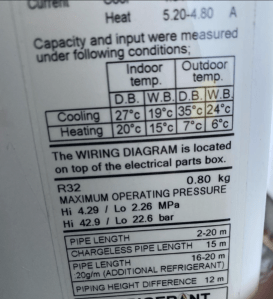
It is also important to mount the unit above ground level so that snow does not block the unit from functioning. A HO7RN-F (A rubber/Neoprene flexible cable) 4 core cable is required to connect the outside unit to the isolation switch (red switch shown below) which in turn requires another isolation switch inside that in turn controls both the inside and outside unit.

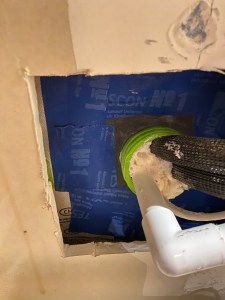
Cables and Ductwork-The cables and ductwork installation for a heat pump with a timber frame construction requires care during installation. When locating the cable and duct route through the wall use a narrow hollow pipe to find a path through the insulation and then drill through this pipe. If one uses a drill on its own with fibreglass insulation will wrap itself around the drill and leave thermal gaps in the wall and result in thermal bridges. The method I used is shown below. I used a rubber airtight gland to seal the larger duct. Ensure that this hole is mechanically sealed during the interim works from any rodents entering your build.

Power Usage-For year one of the installation I experimented with different settings -example using a high heating mode during off peak lower cost electricity and then returned to lower heat output during day. For year two I will set the unit at 50% of its output heating capacity and try an option called ECO mode which automatically reduces the temperature over time. For the last two weeks in this mode (October week 1 and 2) the unit used 20Kwh (€5 @ 0.25 cents per Kwh) to heat the house. The input power used by the air to air heat pump was approximately 300 watts when heat was required. The plan is to increase the number of solar PV panels to offset this 300 watts during daytime use. The power consumption varies as the external temperature changes. In the first year we used between 28Kwh per week up to a max of 50kwh during the first year of experimentation during the winter heating season. A power meter is now installed to record the daily/weekly and monthly power usage as shown below.

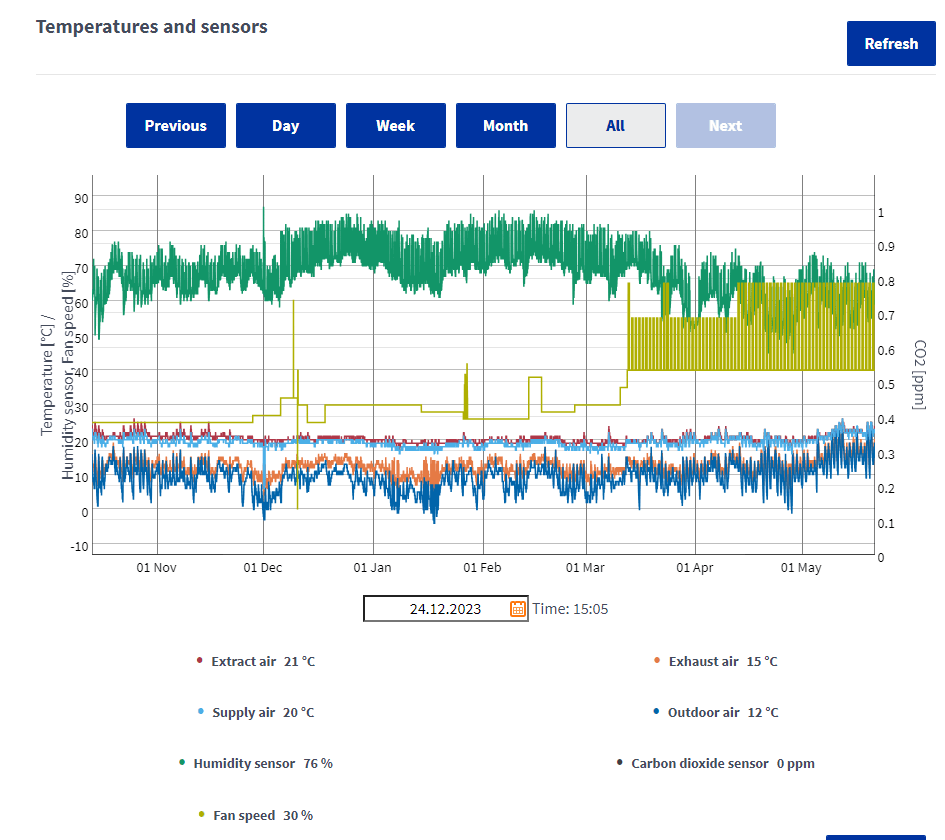
Below is the HRV (Heat Recovery Unit) temperature /humidity plot over the 2022-2023 winter period with the air to air heat pump. I reduced the HRV fan speed to minimise the amount of energy consumed in the winter time and increased it at the end of the winter season as shown below .
Internal Unit-The internal unit requires a height above floor level of 2.4 meters and at least 65mm clearance above the unit. In our installation there is approximately 1000mm clearance above the unit to allow the unit to blow air upwards to ensure a more balanced room temperature and air flow in the room. This is a built in function of this particular unit .

Further Experiments and Research-I am also experimenting with a secondary heat distribution unit to improve heat flow around the living area of the house in year 2 in order to optimise the temperature differences one finds at ceiling height versus floor temperature.

Using a Heat Pump (Air to Air) to heat a house-Part 1

Selection of a Low cost heating system for a passive house.

There are a number of options to heat a home when energy efficiency is designed into the build from day one. This statement is particularly true when one aims for the passive house performance standard using the PHPP (passive house planning package) software. When we moved into the house one will see from a previous blog that we started out with two storage heaters to heat the house with off-peak electricity with a capital cost of €70 (One storage heater was free and the other we paid €70 ).

Times have changed and the next energy crisis came along in 2022. We now have switched to a 1.6 kw air to air heat pump . These units are cheaper to run and more efficient than other types of heat pumps or heating systems. The other reason a dedicated home heating single unit was selected was to simplify maintenance. The hot water system is independent of the house heating.

One benefit of using an air to air heat pump to heat the house was the realisation that in Ireland when one returns home after being exposed to a damp cold climate it was difficult to thaw out quickly when the whole house temperature was 20/21 degree Celsius when using the storage heaters. By careful placement of the heat pump one room in the house is now at a higher temperature. This almost equates to a fireplace being available to help drive out the dampness one absorbed. We also noticed the room is used more frequently.

The room we selected was the kitchen/dining room. I feel it is important to ensure that the warm air the unit is blowing out does not interfere with the area one uses near or under the unit. This particular unit has an upward air circulation option that can limit this but we still installed it in an area that is not a functional working or sitting area.

To select the correct size of a heating source one needs to review the passive house PHPP software for your home. In principle the passive house standard selects the coldest day of the year for this calculation. In Ireland the PHPP software uses local climate data installed in the software to calculate the heating required for the house. This equates to approximately 1kw of heat for every 100m2 of floor area. As our home is 200m2 we needed 2 kw output on the coldest day of the year (similar to the power a toaster or hair-dryer uses for the coldest day).

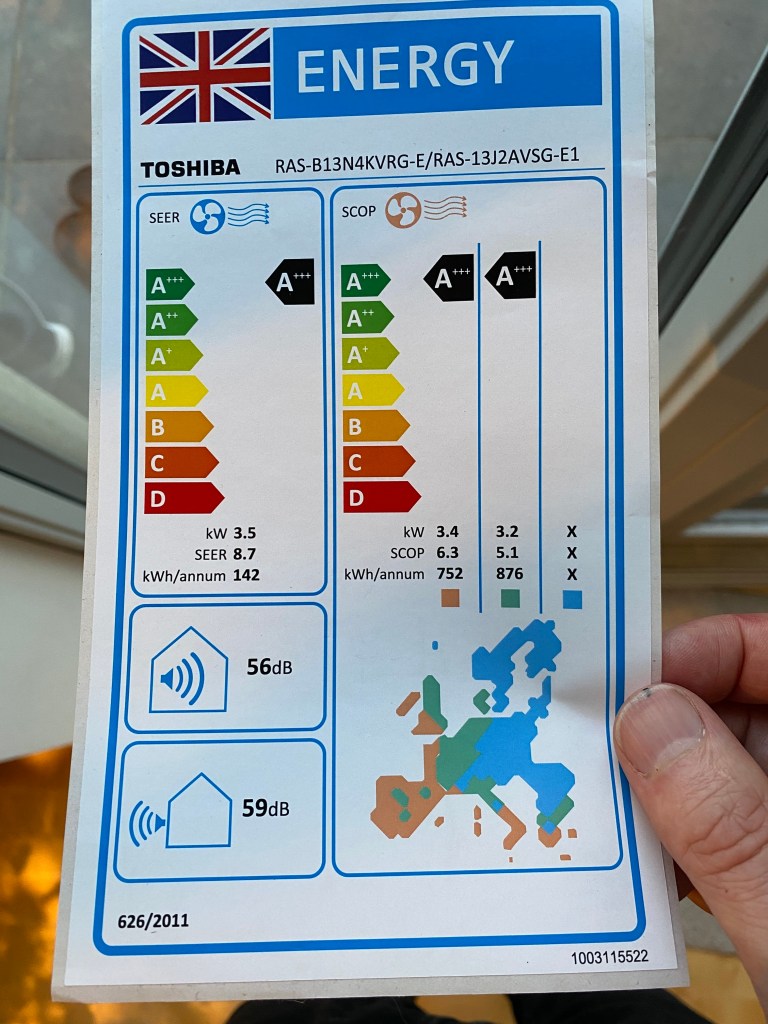
The Air to Air heat pump we used was the RAS-B13J3KVSG-E internal unit and the RAS-13J2AVSG-E1. These were one of the most efficient and economical units I could find. The price of the unit was around €600. Installation was another €1000 approximately. There are designer internal heat pumps options available from the same brand if one want to make the unit a design feature.

How the heat pump works -All heat pumps harness the natural heat energy present in the environment, air-to-air heat pumps can amplify the input power, resulting in a higher output. This is known as the Coefficient of Performance (COP), which measures the ratio of output power to input power. A higher COP indicates greater efficiency, and air-to-air heat pumps typically have a COP of 3-4, meaning they can produce 3-4 units of energy for every unit of electricity consumed. The air to air heat we installed has a SCOP of 6.3 and the designed heating load for the year is 752kw/h per annum. This approximately equates to €25 a month for a 7 month heating season @23 cents a kw/h. The letters SCOP is a seasonal calculation for the full heating season. In our unit the COP can produce 20 degrees inside if the temperature is 7 degrees outside.

There is also a function to cool the house with an air to air heat pump when global warming arrives in Ireland. Ireland missed the global warming cycle this year (2024) so we did not need to use this function.

Part 2 -Installation, performance and lessons learnt after 1 year of use…to be continued

Window/Door Thermal Bridge Detail

Installation Detail

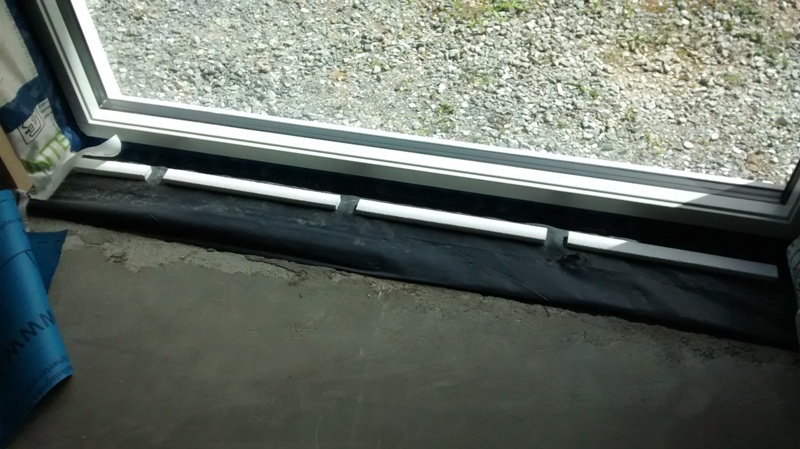
Below is the plan to deal with the window/door threshold detail to minimise thermal bridging and provide airtightness.

The window sits on a 30mm piece of Compacfoam . I used Compacfoam 200. I rebated the Compacfoam under the window so that the floor boards would fit under the window and sit on the non rebated edge.

frame mounted on compacfoam with a routed rebate
Compacfoam 30mm with rebate (Used router to rebate)

I placed 15mm Compacfoam along the lenght of the window and glued these with Orcon F.  The direction of the Compacfoam will determine the floor board direction.

compacfoam
Strips of Compacfoam

I then used 15mm Aerogel to seal around the Compacfoam. Under the window I installed the Proclima profil tape so that I could tape the Intello membrane later.

I left the centre protection tape in place on the Intello profil so that the wooden floor would go in as far as possible on the membrane.

aerogel
Aerogel 15mm

The Intello membrane was then taped ensuring that it was placed as near to the window as possible .  I taped the membrane to the floor . This finished the detail.

proclima
Proclima Solitex Plus in place

An example of the possible future wooden floor sample in place is seen below or stone/slate or marble finish.

floor board

I will first seal the floor with a product from Lakeland paint in the UK in order to minimise dust. (It looks like a very high eco specification sealer ).

I then plan to install a marble /stone slab to bridge the gap and connect this to the wooden floor.


Thermal Bridges

As part of the passive house requirement one needs to eliminate or minimise heat loss through linear lengths or points around the house. Some of the thermal bridges in my build are typical of other builds. I hope to provide more details in the future.

One of the main linear heat losses is with window/door installations (its connection with the wall frame ). It has been said numerous times that selecting a high quality window/door and installing it poorly can equate to buying a low energy window .

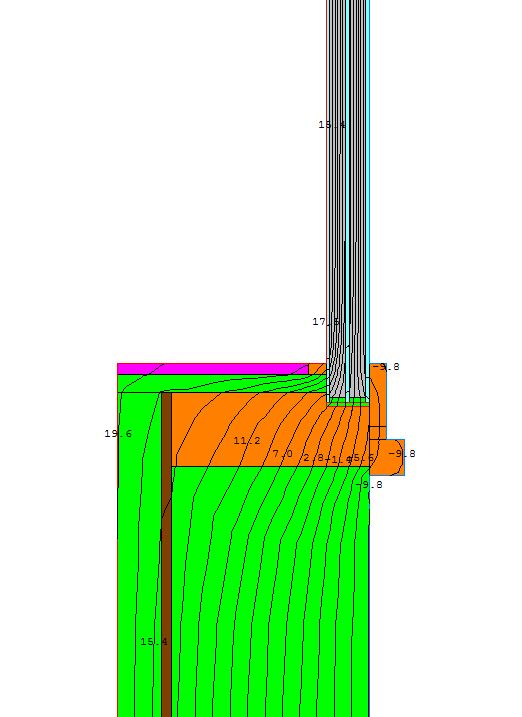
As mentioned before I will use the free software called Therm to calculate the losses. The first detail to tackle is the glazing which was directly mounted in the frame of the house without a window frame.  These windows are 2.4 metres x .9 metre and there are 11 of these mounted on the south face.

The calculation of these linear losses can be expensive to get done so I will be doing the task myself and have it checked by others. I am surprised that good details are hard to come by on the web for free to help the self builder. One of the most time consuming exercises with thermal bridge calculations is drawing the detail. If one undertakes drawing this oneself using CAD (Computer Aided Design) software it can help to reduce the cost of the calculation.

When one needs to come up with a detail to minimise the losses there are a lot of products that help to keep the losses under control. These are semi-rigid insulation products like compacfoam, foamglass blocks, standard insulation, TECTEM, PU or rockwool and fibreglass products and aerogels (which is one of the highest performing insulators being made).

To date there appears to be very few online resources to guide the self builder or provide details that one can use before one starts a build.

Some background and details I found to date on thermal bridges can be found at the following links.

What is a Thermal Bridge

Leeds Beckett University

Scottish Thermal Bridge Details Link

Example of Heat Loss through a glass spacer

Below is an example of the thermal bridge calculations one needs to carry out to establish the thermal bridge performance values in W/(mk).

  • One draws the detail as a DXF file using a drawing package (or draw the detail manually in Therm)
  • Import the detail into Therm Software
  • Add the technical details such as thermal conductivity of each item
  • Tell Therm where on the drawing to stop the calculation (Adiabatic)-top and bottom of the drawing shown below.
  • Tell Therm what the internal and external temperatures are
  • Go to a spreadsheet and calculate the psi values of the thermal bridge detail for the passive house performance value.

When this is done one ends up with the calculation and an image like that shown below. In this image the glass is shown near the top right.

Drawing Detail


In the next image the colours show the temperature gradients. The purple colour is the outside temperature at -10 degrees.

colour infrared
There is thermal bridge software that one can buy where the software calculates the psi value without using a spreadsheet but Therm is free and there are courses available in Ireland.

If one wants to show the real design and installation details of the thermal bridge values for the Irish regulations rather than the accredited details (without a performance value)  one needs to use a certified thermal bridge accessors but this is not the case for the Passive House Institute.

We can all look forward to the day when standard construction details that are typically used in Ireland are already calculated for the self builder and there will be no need to pay to find out the thermal bridge losses . The Scottish accredited details (see above link) come close to taking the guess work out of construction.