Tag Archives: Thermal Bridge

Using a Heat Pump (Air to Air) to heat a house-Part 2

Other advantages of an Air to Air heat pump compared to air to water heat pumps is the ability to supply heating when it is required and quickly switch off the unit if there is solar gain in the winter (the sun has been known to shine in Ireland in the winter months). The air to water heat pump will have a slower response time through the concrete floor.

Installation-The installation of the internal and external unit needs careful design/planning. Both need to be considered at the same time. The factors to consider for the external (Inverter) unit is a location that is not subjected to high winds (higher winds will mean lower temperatures during the heating season and reduced efficiency), mounting the external unit at least 100mm (I used 300mm) from the rear wall (restricting air increases the energy usage). There should be no air flow restrictions in front of the unit either. Mount the unit on a secure and flat surface (the external inverter requires a flat surface so that compressors are balanced to reduce vibration). Vibration leads to lower reliability. The length of the pipework also needs to be considered and noise levels. The maximum noise level for our unit is 61db if on full power.

The external unit requires an electrical isolation switch and a condensation drain for the cooling season (it removes moisture from inside the house).

Power Consumption-The maximum power consumption of the external unit is 1.6kw with a typical power consumption of 1.08kw to produce up to 4kw of internal heating. Typically a passive house requires 1kw of internal heating for each 100m2 on the coldest day of the year . Our home is 200m2 so 2kw is required. The 4kw output power will allow more heat capacity if required. Most Air to Air heat pumps have an option to control the output power using the remote control. One can reduce the power to 50% or 75% of its rating. I will set ours to 50% for year 2 (2024-2025) which approximately equates to a max heat output of 2Kw on the coldest day of the year. This has the advantage for passive house builds of increasing the life of the Heat Pump compressor and ensuring the unit does not use more power than is required. It will also reduce the noise level by 4db (which equates to a reduction of noise by approximately half).

Typical Operation-The operating temperature range of the external inverter is –15 degrees to +24 degrees in the heating cycle. The typical internal heating temperatures achieved for 6 degrees and 7 degrees outside temperatures are shown below. Most heat pumps will also have an automatic defrost cycle when the external unit freezes over due to low outside temperatures. No heat will be delivered inside the home during this cycle and it only lasts a short period of time. If a house is designed with the passive house software (PHPP software) it could take a day or two for the temperature to drop significantly due to the highest air tightness standard in the world (0.6 ACH), quality control around the building fabric and designed to a performance standard.
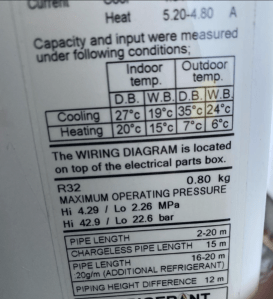
It is also important to mount the unit above ground level so that snow does not block the unit from functioning. A HO7RN-F (A rubber/Neoprene flexible cable) 4 core cable is required to connect the outside unit to the isolation switch (red switch shown below) which in turn requires another isolation switch inside that in turn controls both the inside and outside unit.

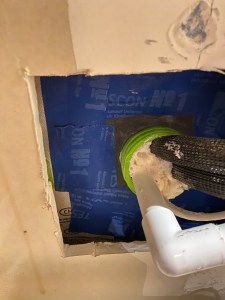
Cables and Ductwork-The cables and ductwork installation for a heat pump with a timber frame construction requires care during installation. When locating the cable and duct route through the wall use a narrow hollow pipe to find a path through the insulation and then drill through this pipe. If one uses a drill on its own with fibreglass insulation will wrap itself around the drill and leave thermal gaps in the wall and result in thermal bridges. The method I used is shown below. I used a rubber airtight gland to seal the larger duct. Ensure that this hole is mechanically sealed during the interim works from any rodents entering your build.

Power Usage-For year one of the installation I experimented with different settings -example using a high heating mode during off peak lower cost electricity and then returned to lower heat output during day. For year two I will set the unit at 50% of its output heating capacity and try an option called ECO mode which automatically reduces the temperature over time. For the last two weeks in this mode (October week 1 and 2) the unit used 20Kwh (€5 @ 0.25 cents per Kwh) to heat the house. The input power used by the air to air heat pump was approximately 300 watts when heat was required. The plan is to increase the number of solar PV panels to offset this 300 watts during daytime use. The power consumption varies as the external temperature changes. In the first year we used between 28Kwh per week up to a max of 50kwh during the first year of experimentation during the winter heating season. A power meter is now installed to record the daily/weekly and monthly power usage as shown below.

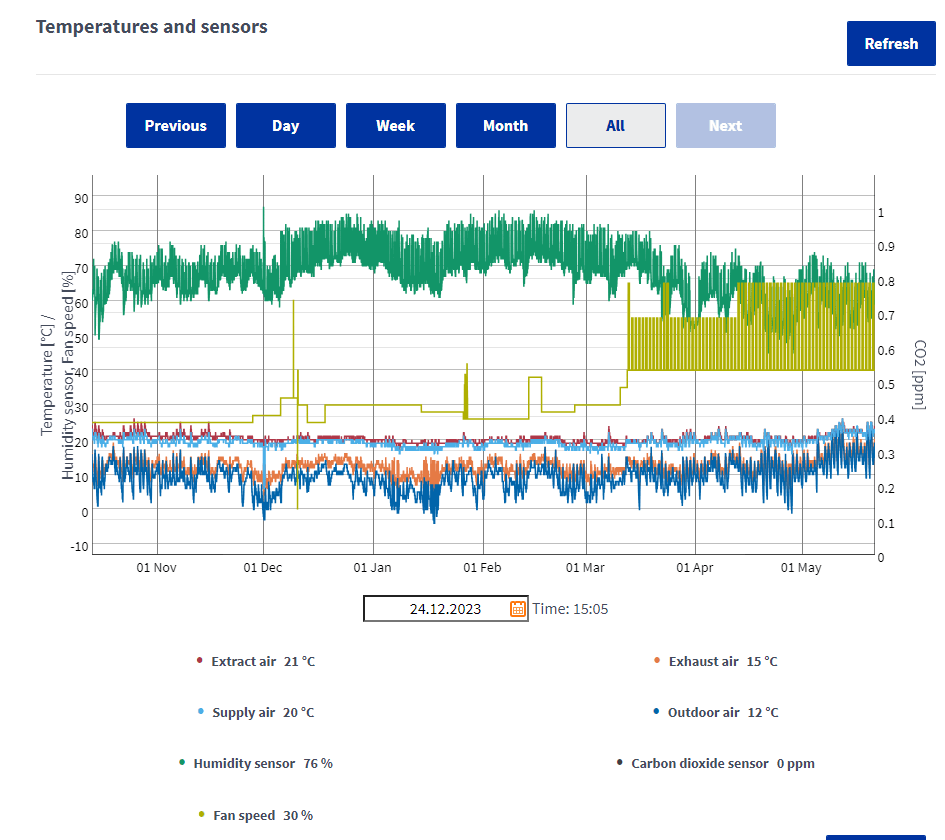
Below is the HRV (Heat Recovery Unit) temperature /humidity plot over the 2022-2023 winter period with the air to air heat pump. I reduced the HRV fan speed to minimise the amount of energy consumed in the winter time and increased it at the end of the winter season as shown below .
Internal Unit-The internal unit requires a height above floor level of 2.4 meters and at least 65mm clearance above the unit. In our installation there is approximately 1000mm clearance above the unit to allow the unit to blow air upwards to ensure a more balanced room temperature and air flow in the room. This is a built in function of this particular unit .

Further Experiments and Research-I am also experimenting with a secondary heat distribution unit to improve heat flow around the living area of the house in year 2 in order to optimise the temperature differences one finds at ceiling height versus floor temperature.
Thermal Bridges

As part of the passive house requirement one needs to eliminate or minimise heat loss through linear lengths or points around the house. Some of the thermal bridges in my build are typical of other builds. I hope to provide more details in the future.

One of the main linear heat losses is with window/door installations (its connection with the wall frame ). It has been said numerous times that selecting a high quality window/door and installing it poorly can equate to buying a low energy window .

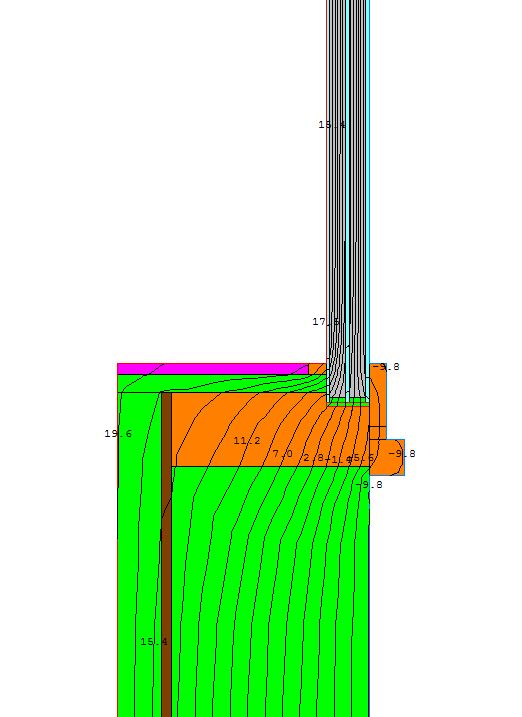
As mentioned before I will use the free software called Therm to calculate the losses. The first detail to tackle is the glazing which was directly mounted in the frame of the house without a window frame.  These windows are 2.4 metres x .9 metre and there are 11 of these mounted on the south face.

The calculation of these linear losses can be expensive to get done so I will be doing the task myself and have it checked by others. I am surprised that good details are hard to come by on the web for free to help the self builder. One of the most time consuming exercises with thermal bridge calculations is drawing the detail. If one undertakes drawing this oneself using CAD (Computer Aided Design) software it can help to reduce the cost of the calculation.

When one needs to come up with a detail to minimise the losses there are a lot of products that help to keep the losses under control. These are semi-rigid insulation products like compacfoam, foamglass blocks, standard insulation, TECTEM, PU or rockwool and fibreglass products and aerogels (which is one of the highest performing insulators being made).

To date there appears to be very few online resources to guide the self builder or provide details that one can use before one starts a build.

Some background and details I found to date on thermal bridges can be found at the following links.

What is a Thermal Bridge

Leeds Beckett University

Scottish Thermal Bridge Details Link

Example of Heat Loss through a glass spacer

Below is an example of the thermal bridge calculations one needs to carry out to establish the thermal bridge performance values in W/(mk).

  • One draws the detail as a DXF file using a drawing package (or draw the detail manually in Therm)
  • Import the detail into Therm Software
  • Add the technical details such as thermal conductivity of each item
  • Tell Therm where on the drawing to stop the calculation (Adiabatic)-top and bottom of the drawing shown below.
  • Tell Therm what the internal and external temperatures are
  • Go to a spreadsheet and calculate the psi values of the thermal bridge detail for the passive house performance value.

When this is done one ends up with the calculation and an image like that shown below. In this image the glass is shown near the top right.

Drawing Detail


In the next image the colours show the temperature gradients. The purple colour is the outside temperature at -10 degrees.

colour infrared
There is thermal bridge software that one can buy where the software calculates the psi value without using a spreadsheet but Therm is free and there are courses available in Ireland.

If one wants to show the real design and installation details of the thermal bridge values for the Irish regulations rather than the accredited details (without a performance value)  one needs to use a certified thermal bridge accessors but this is not the case for the Passive House Institute.

We can all look forward to the day when standard construction details that are typically used in Ireland are already calculated for the self builder and there will be no need to pay to find out the thermal bridge losses . The Scottish accredited details (see above link) come close to taking the guess work out of construction.


Windows (Part I)

How many times did we see on Grand Design or other home build programs the stories of things going wrong with the windows/doors. Now after going through the process hopefully the following may help other self builders.

Technical

First of all the technical detail. The most important element of the windows is the glass. Some important functions-

  1. Capture heat (free energy) from the sun in the winter/autumn/spring to heat the house. (Called the g value)
  2. When the heat is captured or created in the house minimise the loss through the window (Called the Ug value for the glazing. )The Uw or U-value usually includes the whole window (including the frame ) but be aware that some window company’s may quote only the glazing value rather than the glazing and frame.
  3. Minimise cold air draughts (cold air descending at the window surface) that one may feel if one sits near a window (this is caused by the glazing not being able to keep the differential temperature between the inside and outside below 3 to 3.5 degrees Celsius. (eliminated by triple glaze systems)
  4. Maintain a sense of light in the room (the light level can be typically reduced by 30% (for triple glazed systems) when one tries to balance the above factors.
  5. Ensure that west facing and south orientation windows are correctly shaded (or by means of special glass) in the summer/autumn so that the house will not overheat .

The type of glass used in a self build can reduce the amount of insulation required in the house. One has to balance the g value ( g value represents the maximum amount of solar energy passing through the glass and 0.0 or 0% represents a window with no solar energy transmittance-if glass had a 53% = 0.53  g factor it would let 53% of the solar heat through. ) with the Ug value which represents the heat loss over a surface area in W (m2/k).

The glass that works in Germany may not necessarily work in Ireland. One needs to balance these two values to suit your house and orientation in the PHPP software.

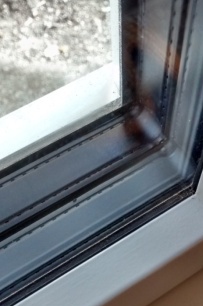
Another important factor is the glazing spacer used between the panes of glass. Most high quality windows will use a thermally broken spacer to ensure that the minimum amount of heat is lost through the glass spacer. One can see this by viewing the colour of the spacer -if is it silver/metallic  then it more than likely has a high heat loss. If it is black it more than likely is a highly insulated spacer.

Window Spacer (Black)


Practical Choice

Options are available in general to have the windows opening out or opening in (with or without tilt and turn).  Tilt and turn mean that blinds and curtains need to be taken into account.

I believe there are only two or three manufacturers of sliding doors that are airtight. Other options are folding units.

  • Review the type of hinges (galvanized, steel, brass etc) and the handles specified (shapes).
  • Some opening out windows/doors have the option of a locking system  to ensure that a breeze will not affect the ventilation or damage them when left open.
  • Establish which doors need external key locks for entry .
  • Establish how many sets of keys you will receive
  • There is an option to have wooden or PVC windows clad with aluminium (evaluate which is more suitable in your environment such as being beside the sea versus fully sheltered).
  • Ensure the Ral colour touch up paint kit is available for small scratches and knocks that happen on site.
  • Establish if you want alarm contacts pre-installed.

Cost Choices

  • A window with minimum openings (more energy efficient) will be significantly cheaper than a window with multiple openings (less energy efficient).
  • A window that stays within the manufactures standard sizes and truck delivery size is going to be cheaper.
  • A window that has a non standard shape is going to be more expensive.
  • Sliding/Folding mechanisms and making them airtight is more expensive.
  • Establish if one can use glazing without a frame in your design (roughly 50% cheaper).
  • A certified passive house window will be more expensive. See link to certified components- Passive House Institute Certified Components

 Importance of Installing Windows Correctly

The frame that holds the glass and those used in passive houses will have an insulator such as cork or other insulation material separating the inside of the frame from the outside climate in order to reduce the heat loss. An equally important detail of a window is how it is going to be installed. This can account for over a third of the heat loss if it is just placed in an opening and secured with a steel band/bracket and then foam filled around the edges. So in real terms money spent on a high performance window/door can be negated completely by installing it poorly.

Below is a video I came across for guidance on installing windows  in a timber frame build (Ireland) with a breathable insulation on the outside and a sketch of an externally insulated block work building later on in the video. There are a number of videos in this series.

In my case I installed the windows in a wooden frame on a ventilated facade. As wood is a fairly good insulator (thermal conductivity of approximately 0.13w/(mk) ) I took the extra step of providing a better insulator around the reveal in order to improve the installation method and reduce the heat loss on the frame as the external cladding is vented with cement board. I am in the process of doing up the thermal bridge calculation using the free software Therm to calculate the actual linear heat loss (Thermal Bridge psi value denoted by the symbol Ψ).  The other type of heat loss is known as the U value and is a measure of surface area in watts per m2 per degree change (W/m2/K).

Where the window or doors were installed on concrete I installed Compacfoam  (rigid insulation) under the window/door and I will insulate and provide an airtight seal up to this material.

Window Frame Mounted on Compacfoam (insulator) in order to minimise the heat loss against the concrete floor.


Glazing (with no frames)

I installed some glazing in the structure of the building without the frames in order to reduce costs. The timber frame manufacturer, Matthew O Malley Timber Limited, rebated the openings and I then taped and sealed the glazing. There were 12 glazing units of 2.4 metres by 0.9 metres approximately.

I installed security tape in the rebate. I experimented with other security tape but found the following tape to be better-Closed cell polyolefin foam tape which conform to BS 7950 Manual Glazing Test from tapes direct in the UK.

Glazing openings with rebate in timber.


As the structure of our home is made with gluelam this helps to minimise the movement in a timber frame build to facilate installing glazing without a frame. I am not sure if glazing can be installed directly in a standard timber frame build.

Other important factors to consider are:

  • air-tightness (the normal passive certified window will have two or three seals mounted in the frame) .